A hint about good presentations, Politics as an example of transparency? and OMMA Social
The best speakers bring authenticity through personal stories.
It was easy to focus on Rich Ullman‘s lunchtime talk during OMMA Social today as he creatively wove in stories and slides from his experience over the last 48 hours. (Sorry about that olive, Rich.)
He made a point about transparency making newly appointed U.S. Senator Gillibrand an example. With the news around her appointment, he’d just learned that as a congresswoman, her Sunlight Report broke ground making her the first to list her official schedule daily (who she is meeting with) and among the first to disclose all her earmark requests and post her financial disclosure reports.
Cool!
Take it one step further:
I’d love it if every member of congress had a Twitter feed updated as they went through their daily meetings and proposed, amended, or voted on budgets or legislation. Following those I vote for would be manageable and give me a much deeper awareness and sense of engagement.
[Rich was kind enough to upload his slides to Slideshare within an hour of my request. Thanks!]
[You might also be interested in live blog posts about each presentation at OMMA Social by @dberkowitz]
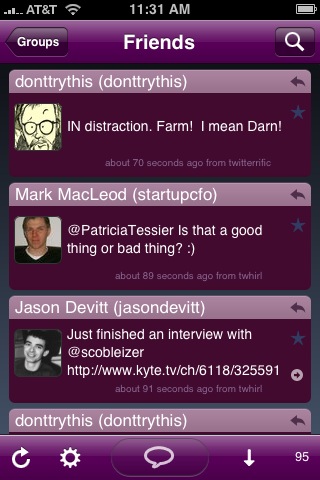
Best iPhone Twitter app comes down to Tweetie vs. Twittelator Pro
Gizmodo’s new comprehensive review of iPhone apps evaluated many more than I did (“ten zillion”), but matches my own experience. We both narrow it down to Tweetie vs. Twittelator Pro.
I’ve been switching back and forth between the two for the last month or two. Either is a great app with the edge for smoothness going to Tweetie (which also seems to display more tweets on the page). The edge for pure power goes to Twittelator Pro.
Twittelator has a great feature I wish was included in other iPhone apps: a button to scroll down a whole page at a time. This is especially useful in catching up with a long list of tweets. This is the only app I’ve seen with this functionality, so it’s a nice innovation.
The other power feature I make use of in Twittelator is the ability to define my own saved searches.
I can’t think of anything in Tweetie that Twittelator doesn’t do (well, there are fart noises and the flashlight if you enable the Popularity Enhancer).
Despite all that, my current swing is in favor of Tweetie, though I still switch it up. Which do you prefer?
Suing over negative Yelp reviews (and a better response)
A friend of mine, Michael Blacksburg, represents defendant Christopher Norberg in a case where a chiropractor has sued over a negative review on Yelp. They’re in mediation today, trial in March if it doesn’t settle.
The case raises complex issues for everyone such as:
- where are the lines between fact and opinion
- how much should that legal distinction apply to consumer review sites?
- how should online review sites be structured to be fair to both sides?
- how should they handle negative comments?
- how should reviewer reputation and identity contribute?
- what about anonymous reviews?
The Chron has a good story (and an editorial), and I liked PC World’s review of the lawsuit and they had a lively discussion on NPR’s Forum this morning with an attorney from the EFF (who threw one hell of a great birthday party earlier this week).
How should businesses participate in the process and respond to negative comments online?
I’m in the camp that says the lawsuit does chiropractor Steven Biegel far more harm than good (no matter what the outcome). Everyone would be better off to handle these issues conversationally than legally.
I like the suggestion ‘from Sharemarketing’: Don’t sue your way out of a bad review on Yelp:
Suing is the exact wrong thing to do. Why not go onto Yelp and respond. Say something like this:
“I respect the opinion of Mr. Norberg, a client of mine from date to date. But I think his characterization of me is wrong. I’m honest and hard working, and I’ll work hard to solve the issue you have. Also, my rates are public and agreed upon before treatement. I’m not sure what specific disagreement Mr. Norberg had with me, but I wish he would have talked to me directly instead of using Yelp. Call me anytime, night or day and I’ll happily explain how my treatment works, and I’ll let you know the rates.”
UPDATE 2:36pm 9-Jan-09 Blackie texted to tell me that the case settled to the mutual satisfaction of both parties. (The issues raised, however, remain for all of us as we move forward online!) Elinor Mills at CNet provides great coverage of the settlement.
Obama’s Blackberry: “They’re going to have to pry it out of my hands”
The NYT explains about Obama’s Blackberry: “Attached to his belt for years, he has vigorously argued, [it is] an essential link to keeping him apprised of events outside his ever-tightening cocoon.”
Obama on why he’s being asked to give it up: “This is a concern, I should add, not just of Secret Service, but also lawyers.”
I still propose that Obama should not give up his Blackberry, but keep it and put it to even better use. Don’t secure it, free it!
(UPDATE 1/12/09: a couple of interesting posts on the BarackBerry over at CrunchGear geek out on the issues today.)
iPhone vs. Blackberry: Touchscreen no substitute for good user experience
A new study of user satisfaction thirty days after purchase confirms what some have been saying all along (see previous post Storm vs. iPhone: Experience not Features).
Touchscreens no substitute for good user experience.
Despite several shortcomings, the iPhone user experience is great for a variety of consumer and smartphone uses. The iPhone UX isn’t a function of the touchscreen (or any other feature) but of overall design.
On the other hand, all but the Blackberry Storm are great purpose-made devices for reading and writing email. Highly recommended if that’s your primary use for a smart phone. RIM optimized the Blackberry UX
The Storm, on the other hand, just blows.