iPhone hype and App hype exceeded by results: iTablet / iSlate to match it?
Along with all the hype before the first iPhone was released, I added my voice, noting that it would forever change the mobile phone business in important ways. I camped in line to be among the first to get one. There was enormous hype. Yet, in the two and a half years since, more change happened than most hype predicted.
When the iPhone app store was announced, I predicted that even the most optimistic scenarios projected by analysts were likely to fall short of the mark. It seems that apps have also changed more than even the hype suggested — they were off by even more than I’d thought.
So what will become of the Tablet that Apple announces this morning? Is it possible that the hype will be exceeded only by the results?
Until I learn more about what is being released, I suspect that there will always be a larger market for devices in a phone form-factor than in tablet factor. I doubt that tablet sales can even eclipse laptop sales within the next few years. Yet, there is the possibility that this will change as much about publishing as Apple has already changed about music, mobile and apps, and that computing will be further changed in the process.
I’m not sure what to predict, except that I hope there are some surprises today beyond what I’ve listed below and others have been predicting!
Display: With all the talk Apple has been doing with print publishers (books and magazines), I hope they’ve included a fantastic high-resolution display (OLED would be great), showing off images as good or better than some magazines.
Voice: Ironically, the thing iPhone seems to do least well at is voice. One wants to shout “it’s a phone, dammit!” Since the tablet will have a much faster processor and more memory than a phone can support, it will have even more capacity to support great voice recognition and speech as alternate input and output. It might even have a larger antenna with better wireless performance so that it drops voice calls less often (whether VOIP on WiFi or carrier voice).
Keyboard: Apple’s great little bluetooth keyboard will make it easy to use the tablet to enter long text and work as a laptop replacement.
Storage: Hopefully the machine comes with enough storage and the operating system includes better support for easily building all applications to work seamlessly offline or on. Of course, we expect Apple to announce working with other carriers today as well, but with the rapid shift to mobile data, all carriers may soon have the problems we currently face with AT&T.
Apps: Hopefully Apple realizes how important it is to have a seamless experience across computer, phone and tablet. I want my data and applications to work across them as in science fiction, where I can swipe to send a screen to my other machine, or to a colleague’s. And I want the app store ecosystem to include more than just mobile so that desktop apps can be monitized as well as mobile apps. I’ve been hoping for a Mac App Store for two years.
Depending on price, features and partnerships announced today, Apple might just have a three-peat on it’s hands: extending to the iTablet (or whatever they call it) hype that is exceeded only by the reality.
Check your plan: new lower cell voice rates not automatic
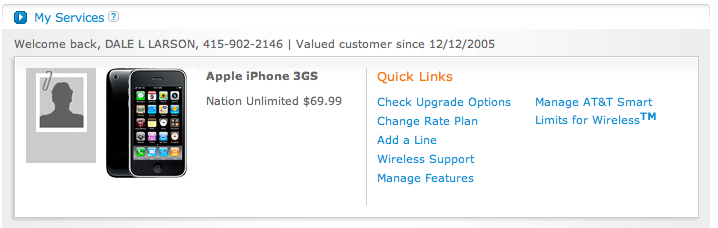
You’ve probably seen the ads: both AT&T and Verizon have dropped their rates for unlimited voice plans to $69.99 per month. But if you aren’t already on an unlimited plan, you may be paying more for less until you take action.
For example, I was on an $89 voice plan that gave me 1350 minutes a month with rollover. AT&T was going to happily keep charging me $20 per month extra indefinitely. (I effectively had unlimited minutes already — with text and data becoming my dominant means of communication, I had accumulated tens of thousands of rollover minutes.)
I went online to login and make the change to my account. In approximately 90 seconds total, I switched and am now paying $69.99 per month for unlimited voice.
So now my iPhone costs $120 per month ($30 data plan and $20 unlimited texting) before taxes and fees (and apps!).
The change means that AT&T now effectively offers only two voice plans — the only other plan that might make sense is 450 voice minutes for $39.99. So if you’re sure you’re not ever going over on voice minutes, you could save $40 per month. Since AT&T keeps dropping my calls, that’s going to be tempting for me as I start giving out my Google Voice number and using my Google Nexus One phone on T-Mobile more.
Hopefully, dropping voice rates isn’t just the prelude to the carrier’s plans to raise data rates.
2010 Year of the App Phone (Android vs. iPhone vs. WebOS)
2008 and 2009 were all about the iPhone. Smartphones were obsolete, nothing else came close. That will be different this year. 2010 is the year of the App Phone.
Last week I looked at the version of a common app on Droid vs. iPhone. The iPhone still won hands down. (Not that a great app couldn’t be delivered on Android, but iPhone has been so much more successful that developers still prioritize it far above the others.) Why will that change this year?
iPhone has the lead in most areas as the most polished and intuitive device with the most apps. But Android and Palm are set to rapidly gain enough market share and maturity of their own to stand up as viable competition.
And they’re all being freed of carrier lock-in. Palm announced WebOS handsets for Verizon. AT&T announced that it will sell Android and WebOS. iPhone may be available on carriers other than AT&T as soon as June. Google has announced its Nexus One, and many more Android handsets are sure to come this year.
For me personally, this means a big change. I am, afterall, the guy who camped at the front of all three previous iPhone lines.
But at least in San Francisco and NYC, the experience of being on the AT&T network is bad enough to drive one to accept a distant second best phone in order to avoid dropped calls. I ordered a Google Nexus One yesterday. Now I’ll have two phones, one that’s good for apps and one that’s good for phone calls and Gmail. I’ll have to carry both until one does it all for me again. (Maybe I’ll even pick up a Verizon WebOS handset.)
On the one hand, I’m a little sad that I have to carry two devices. I thought the geeky habit of having two kinds of computers was a habit I broke a long time ago. On the other, these are exciting times — it’s been a long time since the competition and advancements have been significant enough that I considered using two computing platforms. Twenty-ten looks like it’ll be a fun ride.
Update: Harry’s having the same problem with AT&T coverage, and taking a vote on what he should do about it.